
Skull Base Surgery: Complex Microsurgery on the Brain’s Supporting Pillars
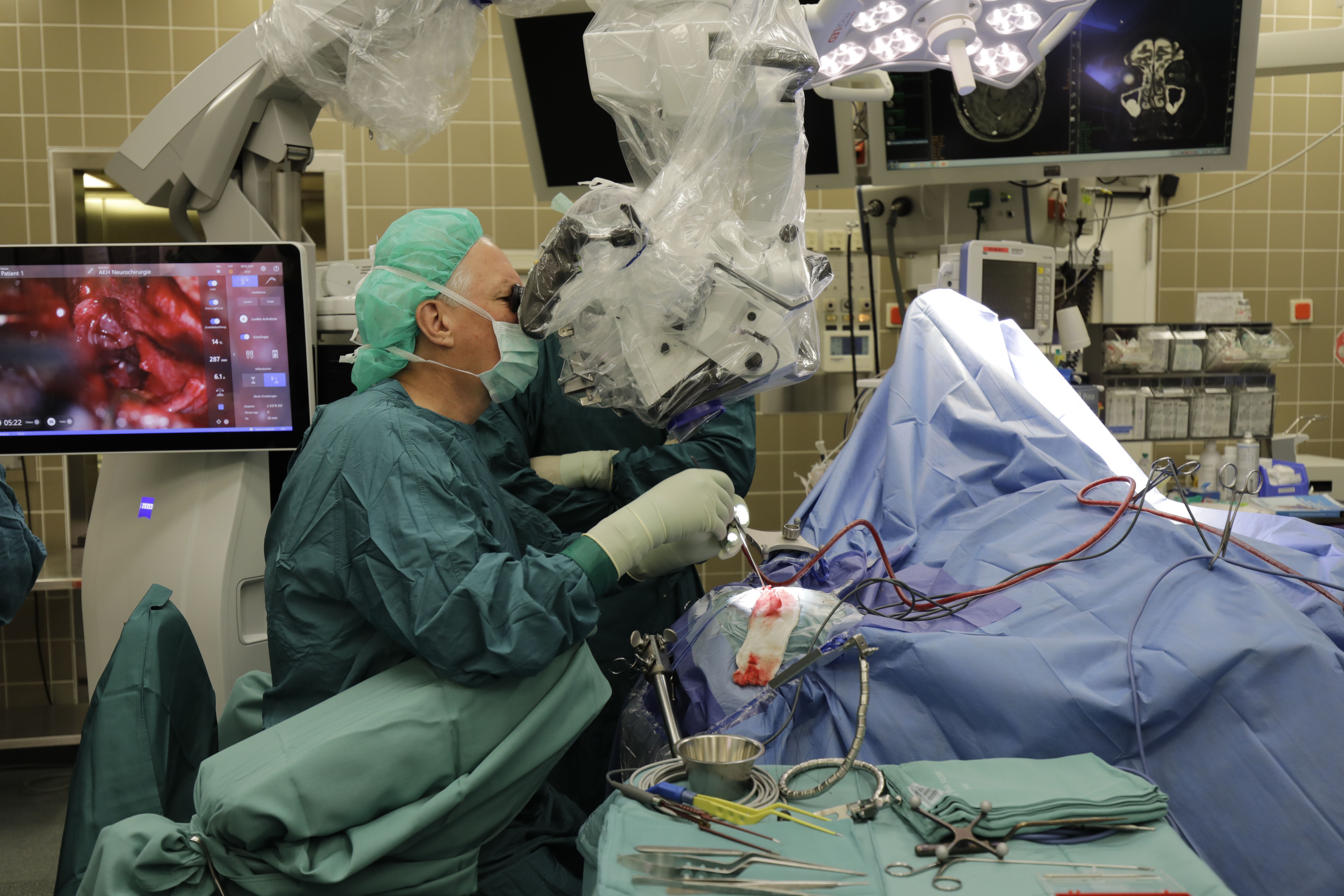
Skull base surgery has a long-standing tradition at the Vienna University Clinic for Neurosurgery, and over the years our clinic has become a nationally and internationally recognized center for skull base surgery. In the course of continuous development, modern, forward-looking techniques have been integrated into daily clinical practice, such as endoscopic skull base surgery, multimodal image-guided neuronavigation, intraoperative MRI, piezosurgery, cryosurgery, and intraoperative neurophysiological monitoring.
Through the establishment of the Skull Base and Neurotraumatology Specialty Clinic and the Interdisciplinary Skull Base Board, we ensure optimal individualized pre- and postoperative care for our patients.
Microsurgical and endoscopic procedures on the skull base account for approximately 20% of all cranial surgeries. These procedures cover the entire skull base, including the cranio-cervical junction, with interventions in the facial region (transfacial)—for example through the mouth (transoral), the nose and paranasal sinuses (transnasal, transmaxillary, etc.), and the orbit (transorbital). They also include surgeries of the anterior cranial fossa (including transbasal approaches), the middle cranial fossa, the central skull base (in the sellar/perisellar region), the posterior cranial fossa (including the temporal bone, transpetrosal) and extending to the cranio-cervical junction (far lateral approaches, trans-cervical, etc.).
Access approaches range from “simple” standardized skull base routes (subfrontal, laterobasal, pterional, subtemporal, retrosigmoid, etc.) and their numerous modifications to highly complex combined—or often multi-cavity—approaches (e.g., transglabellar, transbasal) such as orbito-zygomatic variants, combined supra-/infratentorial approaches, far lateral trans-cervical, or transjugular procedures.
The cases treated span all age groups (from newborns to the elderly, with the oldest patient being 92 years old), encompass all pathology types (vascular, tumor, trauma, reconstruction), and predominantly involve benign conditions (approximately two-thirds of cases), with malignant conditions representing about one-third of cases.
Neurotraumatology at the University Clinic for Neurosurgery
The care of patients with traumatic brain and spinal injuries (involving the spinal cord or cauda equina) is a core competency of neurosurgery and is therefore an integral part of both the clinical and scientific activities of our clinic.
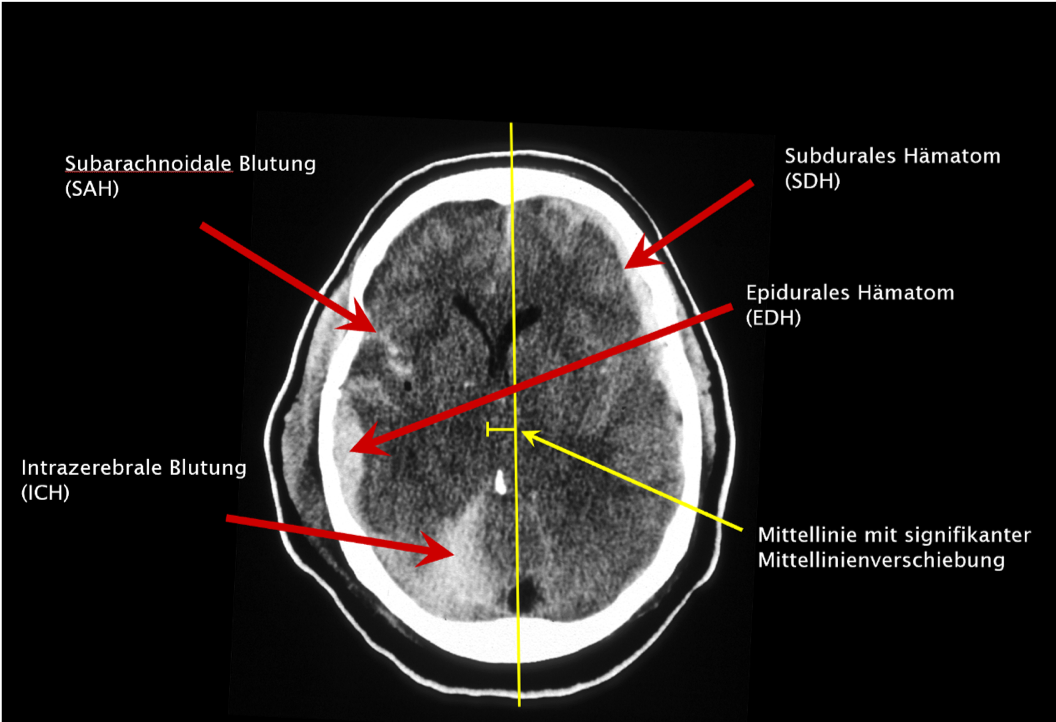
Neurotraumatological procedures account for approximately 12–15% of all surgical services provided by our clinic. Indications include classic trauma-related hemorrhages such as intracerebral hematomas, epidural hematomas, and subdural hematomas (acute, subacute, chronic). Additionally, we treat fractures of the cranial vault and skull base (frontobasal coverage), posttraumatic cerebrospinal fluid circulation disorders (hydrocephalus), vascular injuries of the skull, and posttraumatic cranial vault reconstructions.
Over the past 50 years, the surgical approaches for treating patients with traumatic brain injuries (TBI) have not only been refined and perfected, but new non-surgical treatment options have also emerged, largely due to advances and insights in neurocritical care.
Progress in research has driven a paradigm shift in our understanding of the physiology of both healthy and injured brains. The traditional focus on reducing intracranial pressure (ICP) through mass removal has been complemented by increased awareness of the role of ischemia in the context of TBI.
Inter- and multidisciplinary approaches play a pivotal role in the diagnosis and treatment of traumatic brain injuries. In this context, collaboration with the University Clinic for Orthopedics and Trauma Surgery has been intensified, encompassing both preoperative and postoperative care of patients.
Clinical Working Group for Skull Base Surgery and Neurotraumatology
Head:
Ao.Univ.-Prof. Dr.med.univ. Christian Matula
Deputy:
Priv.-Doz. Dr.med.univ. et scient.med. Matthias Millesi