
Scientific Working Group for Brain Tumor Surgery: From Finger Dissection to Image-Guided Surgery with Navigation, Robotics, and Intraoperative MRI
The aim of the Neuro-Oncology scientific working group is to gain insights into the molecular and genetic aspects underlying tumor development, progression, and treatment resistance.
By investigating the biological mechanisms of brain tumors and analyzing clinical data, the working group seeks to improve patients’ quality of life and to develop and optimize new therapeutic strategies.
Research focus areas:
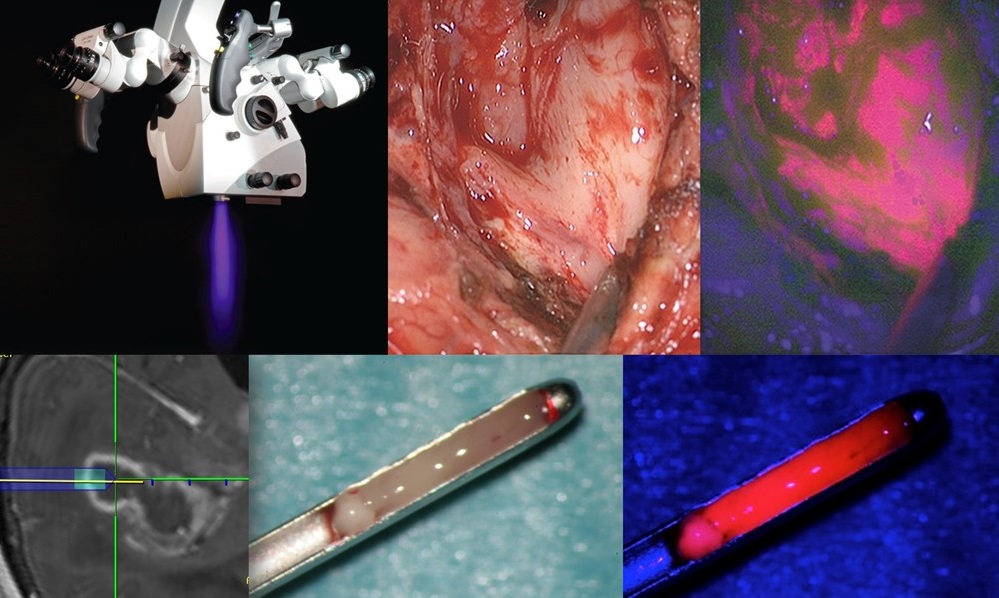
Fluorescence technology using 5-ALA (5-aminolevulinic acid) is an innovative method used in the diagnosis and treatment of brain tumors. In this approach, patients are administered 5-ALA prior to surgery, which accumulates in tumor cells. Under specialized lighting, the tumor cells then emit a characteristic fluorescent glow, enabling the surgeon to identify and remove the tumor more precisely. This technology helps preserve healthy tissue and improves surgical accuracy.
Initially, this technique was used only for rapidly growing primary brain tumors. The Department of Neurosurgery at the Medical University of Vienna has, in recent years, become one of the world’s leading centers for research into new applications of 5-ALA fluorescence technology.
To date, more than 1,500 procedures using this technique have been performed at our clinic, with results published in several renowned journals. In addition, research collaborations with prestigious international institutions have been established.
Tumor immunology is an interdisciplinary field of research that encompasses both basic science and clinical applications, investigating the interaction between the immune system and tumor cells with the aim of developing new therapeutic approaches for combating cancer.
The Neuro-Oncology working group at the Department of Neurosurgery played a key role in conducting a nationwide Austrian clinical study, as well as in the accompanying immunological and molecular biological research on an innovative experimental form of cancer immunotherapy for glioblastomas. The resulting scientific work was carried out in cooperation with numerous institutions, including the Laboratory for Tumor Immunology at St. Anna Children’s Cancer Research Institute (as the developer of the immunotherapy technology), the Devision of Neuropathology and Neurochemistry, the Division of Clinical Oncology, and the Center of Cancer Research of the Medical University of Vienna.

Tumor heterogeneity refers to the genetic, molecular, and cellular diversity within a tumor. Cells within the tumor can exhibit different characteristics and behaviors, and may therefore respond differently to treatments. This heterogeneity can be based on both genetic mutations and epigenetic changes.
The phenomenon of “tumor heterogeneity” has already been analyzed at the DNA level in glioblastomas, the most common and aggressive brain tumors in adults. However, for a long time, epigenetics—i.e., gene-regulatory mechanisms that do not alter the DNA sequence itself but rather its interpretation—received comparatively little attention.
Johanna Klughammer (CeMM, Research Center for Molecular Medicine) and Barbara Kiesel (Department of Neurosurgery) were the first to comprehensively investigate these epigenetic changes. The results of this study were published in the journal Nature Medicine (IF 2021: 87.241) under the title “The DNA methylation landscape of glioblastoma disease progression shows extensive heterogeneity in time and space.”
Not least, this study serves as an example of how samples collected during routine clinical practice can be used for genome-wide molecular analyses to better understand complex diseases and to gain relevant insights for the development of personalized therapies.
The Neuro-Oncology Working Group Team:
Head:
Assoc. Prof. Priv.-Doz. Dr.med.univ.et scient.med. Georg Widhalm
Publications
E-Mail: georg.widhalm@meduniwien.ac.at
Deputy:
Dr. med.univ.et. scient.med Barbara Kiesel
Publications
E-Mail: barbara.kiesel@meduniwien.ac.at